
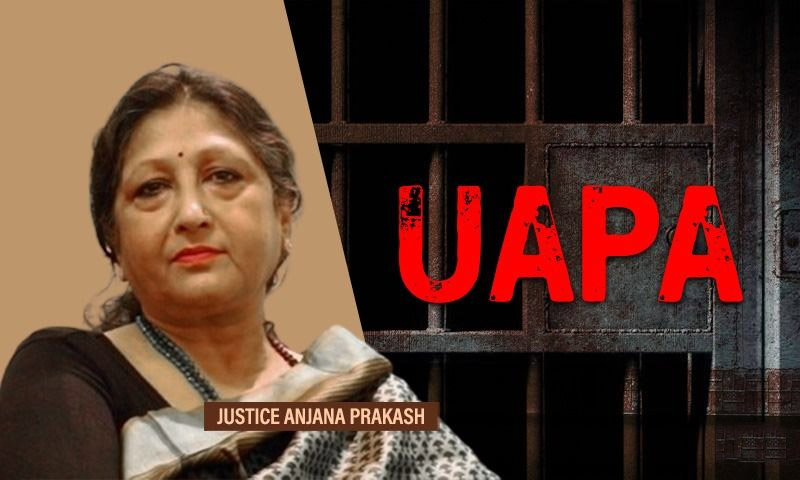
Justice Anjana Prakash is former high court judge who on the last Saturday that while the anti-terror and national security laws are to be used towards the sovereignty and protection of states, in India, they are being used for sovereignty and protection of political parties.
Honorable Justice further says “these laws cannot be permissible because they are so vague”.
In her views the definition of ‘terrorist act’ in section 15 of the UAPA is vague and that is easily susceptible to misuse.
An individual who comes up with any of his views is held and put behind bars. Like when a man said that cow's urine won't help in COVID and it is not good for COVID was put behind bars. If this the direct or indirect effect of the act in our country then there is a higher percentage of injustice done to people rather than delivering justice to the citizens. There are few principles of criminal jurisprudence, like presumption of innocence must not be dislodged, the right on being silence and burden of proof on prosecution should not be taken away as in the case of UAPA. Also, the procedure followed in UAPA is stated to be absurd by justice Prakash. It says that the court has to presume that the accused has committed the offence unless the contrary is shown by the accused.
Justice Prakash quoted Section 12 of the UAPA Amendment Act, 2008, and Sections 43D (5) to (7), which were inserted in the Act to deal with bail for terrorist acts (and not unlawful activity). In other words, unlike other statutes that begin with the presumption that the accused is innocent until proven guilty, the UAPA presumes that the accusation against the accused person is “prima facie” true. But the section 103 of the evidence act says that only the act that are in the persons knowledge has to be proved by them else it is the work of the prosecution who has the burden of proof. It is the charge of the prosecution to prove the charges and just because there is a presumption, this proving of charge cannot be skipped.
Justice Prakash has also pointed out few more drawbacks or loopholes in the sections and the provision in the act which can be misused.
Adding to the comments made by justice Prakash , justice Lokur mentioned the very long trial procedure followed in the cases of UAPA.
Under the act a person can be under detention without even a charge for up to 180 days. Such long periods of pre-trial detention circumvent safeguards in the criminal justice system such as evidentiary requirements and burden of proof, and permit the state to punish those suspected of committing crimes without proving these allegations. Also, under the act the time for police custody can also be increased to 30 days which might also lead to a lot of custodial violence.
Though many studies says that the there is a low conviction rate in both their offences. But still the procedure followed for the trial and pretrial are punishment itself to a person and also these cases are highlighted in the media very often and the person's identity is also revealed even if the person is not found guilty still, they face a lot difficulties and disrespected due to the revelation of their name and identity. And such a long procedure which takes around 180days even without proving allegation is worse than one being punished in any other offence.